Oil Price Shock 2026: Brent Holds at $102 But Middle Eastern Crude Tops $150 as Iran Conflict Disrupts 40% of Supply
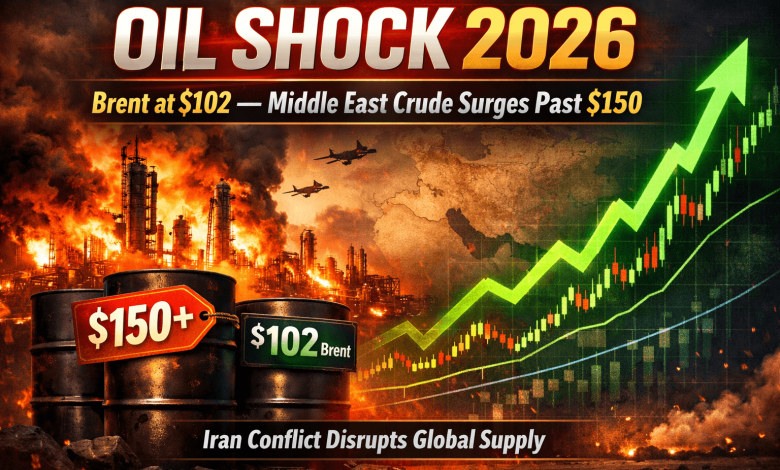
The global energy market is navigating its most significant geopolitical crisis in decades, with oil prices experiencing unprecedented volatility. As the war between the US/Israel and Iran enters its third week, the world is grappling with a two-tiered oil market: benchmark prices show relative calm, but the physical supply situation in the Middle East is critical.
Current Oil Prices: A Market in Flux
As trading commenced on Wednesday, March 18, 2026, oil prices demonstrated the volatile nature of the current conflict. After a sharp rally on Tuesday, markets saw profit-taking and price corrections amid conflicting signals about supply stability.
Global Benchmark Prices (Intra-day, March 18)
- Brent Crude: Trading at $100.85 – $102.60 per barrel, down approximately 1-2.5% from Tuesday’s close. The global benchmark hit an intraday low of $100.85 in morning trading .
- West Texas Intermediate (WTI) : Trading at $92.83 – $95.64 per barrel, down as much as 3.4% at its intraday low .
- Tuesday’s Closing Prices: Brent settled at $103.42 (up 3.2%), while WTI closed at $96.21 (up 2.9%) after Iran launched renewed attacks on UAE energy infrastructure .
The Hidden Reality: Middle Eastern Crude Exceeds $150
While Brent and WTI dominate headlines, they tell an incomplete story. Physical crude benchmarks in the Middle East—which more accurately reflect supply available to Asian refiners—have experienced a historic spike :
| Benchmark | Current Price | Context |
|---|---|---|
| Dubai Crude (Spot) | $157.66 | Highest on record; premium over futures surged from $0.90 to $60.82 |
| Oman Crude (Futures) | $152.58 | All-time high; reflects scarcity of physical barrels exiting the Gulf |
| Brent Crude | ~$102 | Atlantic basin benchmark cushioned by US and European inventories |
This price dislocation reveals that the supply crisis is acute in Asia, which depends on Gulf imports, while the Atlantic basin benefits from stockpiled inventories .
The Strait of Hormuz: Chokepoint Under Siege
The fundamental driver of the current price surge is the effective closure of the Strait of Hormuz, through which approximately 20% of global oil consumption (about 20 million barrels per day) once flowed .
Critical Disruptions
- Supply Loss: Rystad Energy estimates only 12.5 million barrels per day of Middle Eastern oil remains accessible, down from 21 million pre-war. Critically, analysts warn this figure is “not secure” .
- Transit Paralysis: While Iranian-operated vessels and some Chinese tankers have received passage, most commercial shipping remains halted due to safety concerns and the inability to secure insurance .
- US Military Action: In an effort to ease the bottleneck, US forces have dropped 5,000-pound bombs on “hardened Iranian missile sites” near the Strait, according to Central Command .
Allied Reluctance
US President Donald Trump has openly criticized NATO allies for refusing to send mine-sweeping vessels to the Gulf. “This is not our war, we have not started it,” responded Germany’s Defence Minister, while French President Emmanuel Macron stated France would only participate in securing the strait after hostilities end .
Direct Attacks on Energy Infrastructure
The conflict has moved beyond shipping lanes to directly target production and export facilities, adding a supply shock premium to prices .
Fujairah Port (UAE): Iran has launched three attacks in four days on this critical terminal, located just outside the Strait of Hormuz. The latest strike ignited a fire, halting or partially disrupting oil loading at a facility that handles roughly 1% of global demand .
Iraqi Oil Fields: A major southern Iraqi oil field was targeted by drones for the second time in less than a week, an oil ministry spokesperson confirmed .
Saudi & Kuwait: Saudi Arabia intercepted six drones, while Kuwait’s air defences responded to rocket and drone attacks, demonstrating the geographic spread of the conflict .
Market Psychology: The “Trump Put” vs. Physical Reality
A fascinating dynamic has emerged in paper markets. Despite the severity of the disruption, Brent and WTI have not consistently pushed above $120, leading analysts to describe a “Trump put” or “TACO trade”—investors betting that President Trump will engineer a swift resolution .
President Trump has stated the conflict will end in the “very near future” and that prices will fall “very, very rapidly.” White House economic adviser Kevin Hassett echoed this, suggesting the war will last “weeks, not months” .
However, analysts at摩根大通 (J.P. Morgan) and others warn this optimism clashes with physical reality. “The risks remain stark: It only takes one Iranian militia to fire a missile or plant a mine on a passing tanker to reignite the entire situation,” noted IG market analyst Tony Sycamore .
Economic Ripples: Inflation and Central Banks
The oil shock is complicating global monetary policy. With oil prices up nearly 70% year-to-date, inflationary pressures are building .
Impact on Policy
- Federal Reserve: The 5-year breakeven inflation rate stands at 2.6%, above the Fed’s target, potentially limiting the central bank’s ability to cut rates later in 2026 .
- Rate Hikes: The Reserve Bank of Australia hiked rates to a 10-year high on Tuesday, explicitly citing “material” inflation risks from the Iran conflict .
- Consumer Impact: US diesel prices have already crossed $5 per gallon, feeding into broader transportation and goods costs .
Future Outlook: Scenarios and Price Risks
Analysts remain divided on the near-term trajectory, with technical and fundamental factors pointing to continued volatility.
Potential Price Catalysts
- Immediate Upside: Technical analysis suggests WTI faces medium-term resistance at $124 per barrel. Any further attacks on tankers or production facilities could trigger a rapid move toward that level .
- Iran’s Threat: Tehran has threatened to push prices to $200, a scenario that seemed hyperbolic weeks ago but appears increasingly plausible if the Strait remains closed and supply disruptions deepen .
- Demand Destruction: In Asia, there are early signs of demand destruction, with refiners cutting processing rates and some countries banning refined product exports .
Strategic Reserves
The International Energy Agency (IEA) has announced plans to release 400 million barrels from strategic stockpiles, and officials have suggested more could come if needed. While this provides a buffer, analysts caution that stock draws cannot permanently replace lost physical production .
Conclusion
As of March 18, 2026, the oil market is sending conflicting signals. The headline Brent price hovering around $102 suggests a manageable crisis, but the record-shattering prices for physical Middle Eastern crude—approaching $158 for Dubai and Omani grades—tell the real story of acute scarcity .
For investors, businesses, and consumers, the path forward depends on a single variable: When—and if—the Strait of Hormuz reopens to normal traffic. Until then, the world faces a two-tier oil market where access to physical barrels determines price, and the risk of a sustained shock above $100 remains extraordinarily high.
Key Takeaway: While Brent and WTI may offer a false sense of security, the real oil crisis is playing out in the Middle East, where prices have already exceeded historical records, and supply chains are being fundamentally redrawn by war .
Subscribe to our Newsletter
Read Also: